Your phone's camera is already a cardiovascular sensor, it just needs the right software.
moonScan turns an ordinary front-facing camera into a cardiovascular sensor, with no wearable, no contact, no extra hardware. This brief lays out how the technology works, what's real today, and why it's genuinely hard to build.


From a heartbeat to a health metric
Every heartbeat pushes a fresh pulse of blood through the tiny vessels just under your skin.
That pulse briefly shifts how much light your skin absorbs, too subtle to see, but visible to a camera frame by frame.
Watching a patch of skin and isolating that tiny colour wave reconstructs the same pulse a contact sensor would give, with no contact at all.
Each heartbeat also nudges the head by a fraction of a millimetre, an independent motion signal that helps assess quality alongside the colour reading.
The time between beats subtly speeds up and slows down with breathing and nervous-system activity: a window into the body's autonomic balance.
Real, working, quality-gated: not a demo
A 30–90 second face-to-camera scan estimates heart rate, heart-rate variability, and breathing rate today, when signal quality during the scan is sufficient. The system is explicitly quality-gated rather than guaranteeing a result every time.
Blood pressure and stress indices are under active internal development as emerging, experimental metrics. They are not yet presented to users with the same confidence as heart rate and HRV.
Works today in a standard web browser, no install required. A native iOS capture experience exists and is in active development.
Core signal capture and facial landmark tracking run client-side in the browser.
A facial micro-motion signal is captured as an additional real-time indicator of signal quality and stability alongside the primary colour-based pulse reading.
A per-user calibration architecture exists that can incorporate paired reference-device readings to refine personal results over time: real, working infrastructure.
The product includes a real scan-history view with trend and baseline comparison once a user has accumulated enough scans.
moonScan has built an OAuth-based wearable integration architecture (WHOOP) for pairing external reference-device data with scans.
We don't just produce a number: scans can carry a detailed quality profile
Measured capture frame rate, jitter, and dropped-frame diagnostics are recorded for scans when the relevant capture data is available, and can be aggregated for engineering analysis.
A scan's pulse signal is scored for signal-to-noise ratio (in dB) when the signal data is available, as one input among several to a broader quality assessment.
Lighting stability and head/face motion are assessed throughout the scan, not treated only as a single pass/fail check at the end.
The system detects tracking drift and attempts automatic recovery when it loses the face region; recovery is bounded and can still degrade.
Detected beat intervals are evaluated against quality criteria, with exclusion reasons recorded where applicable: interval-level evidence supporting auditability.
The system includes skin-tone-aware adjustments to signal processing, with broader and deeper coverage across skin tones as an active, ongoing area of development.
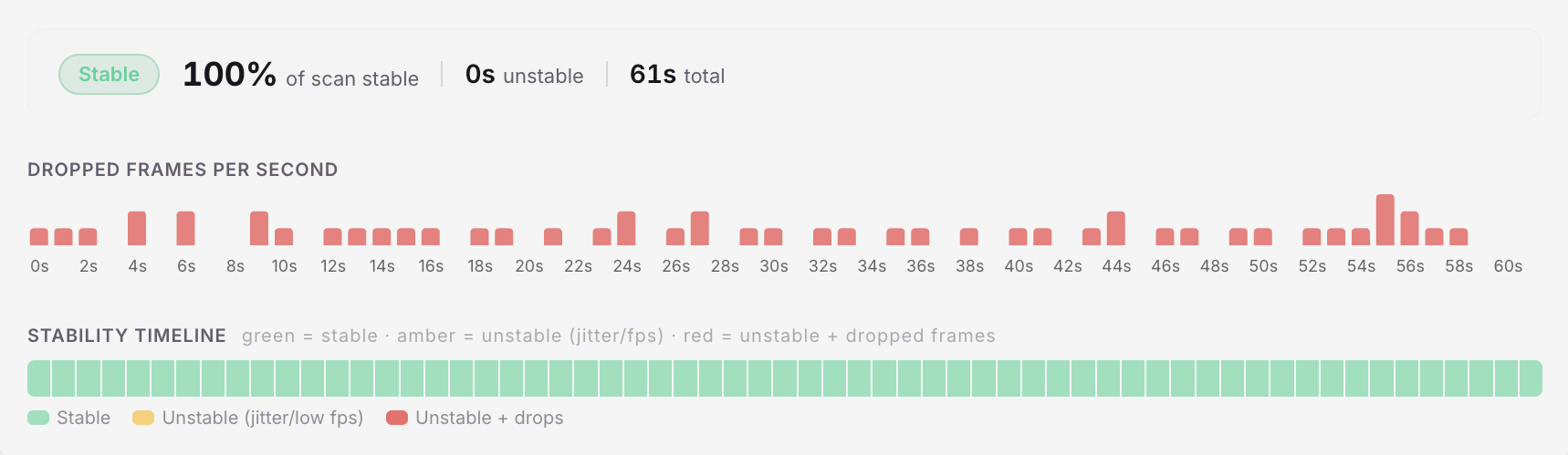

This level of per-scan instrumentation is what lets us reason about when to trust a result and when not to. The instrumentation is backed by internal monitoring tools the team uses to track signal-quality and calibration-health trends across scans.
Simple for the user. More useful with every layer.
moonScan is designed to compound through infrastructure, not through a claim of measured accuracy improvement today. A session can contribute more than a number: it can add structured evidence about signal quality, capture conditions, personal baseline, and—when available—paired reference measurements.
Richer personal history makes trend and baseline comparisons more useful once enough qualifying scans exist.
Paired reference-device readings give the calibration and validation infrastructure more material to work with over time.
Lighting, motion, timing, tracking, and browser differences reveal where the real world challenges a camera-based signal.
Structured scan evidence is designed to feed evaluation and future on-device intelligence—not disappear after a result is shown.
The result is a potential flywheel: camera distribution creates usage, usage creates structured evidence, and structured evidence strengthens calibration, validation, and the next generation of on-device intelligence.
Not a weekend prototype, not an API wrapper
lines in the core signal-processing engine, built and iterated over an extended R&D cycle
lines in a dedicated capture-integrity / anti-spoofing layer
dedicated automated test files covering signal processing, calibration, quality gating, and scan-contract behaviour
Multi-stage, adaptive quality gating with automatic-recovery behaviour: the system doesn't just discard a noisy scan, it actively detects and, where possible, adapts to lighting jumps, motion artifacts, and tracking loss in real time.
Genuine, real cross-platform complexity: browsers and iOS negotiate camera frame rates differently in ways that materially affect signal timing. This is ongoing, active engineering work the team is measuring and addressing with production telemetry.
This is the unglamorous, hard-to-copy engineering work: the part that takes real R&D time and cannot be shortcut with an off-the-shelf model.
In-house R&D infrastructure, not a call to a third-party model
An in-house, offline deep-learning training pipeline has been built using PyTorch, including a custom neural network architecture, a purpose-built composite loss function, and a proper train/validation methodology: original modelling infrastructure, not a call to a third-party API.
The pipeline is built to export trained models for on-device browser inference, and the app includes a browser-side model artifact plus code to load model weights client-side.
The training and evaluation infrastructure is designed to draw on public physiological research datasets (the same class of clinical-grade reference data used in academic cardiovascular research) and is built to incorporate proprietary internal scan data as well.
This pipeline is the technical foundation for a future continuously learning, self-improving on-device model. The infrastructure is already underway today, not just a slide-deck promise.
The last month, at a glance
- Built a frame-timing observability system that tracks capture stability across devices and browsers in production: the foundation for systematically finding and fixing performance issues rather than guessing.
- Identified and corrected a signal-timing accuracy issue in the browser capture pipeline, improving the fidelity of raw signal data feeding every downstream metric.
- Used production telemetry to diagnose real-world frame-rate inconsistencies between browsers and platforms (e.g. iOS Safari vs. Chrome), an active, ongoing diagnostic and hardening effort.
- Actively hardening the scan-capture startup path to reduce device-specific slowdowns before they reach the average user.
- Ships at a high, disciplined cadence: a large volume of tracked engineering increments completed in the past month, backed by a structured internal tracking and QA process.
This is a team that instruments before it optimises: we don't guess at performance, we measure it, in production, across real devices.
Core video capture and facial signal processing run in the user's browser. In the standard scan path, raw video is processed there rather than sent to our servers.
Industry-standard password hashing (bcrypt) and secure, properly-configured session management.
Google and Apple sign-in paths are implemented end-to-end from the login screen through to account creation; availability depends on provider configuration.
Server-enforced access control separating regular users from administrative access.
moonScan's standard scan architecture keeps core video capture and facial signal processing in the user's browser. Certain optional, in-development reference-comparison features can route short video segments through our server to a processing service. We are continuing to harden and verify this architecture in production as we scale.
Healthcare computer vision is growing 32.7% annually
moonScan sits at the convergence of healthcare computer vision, AI-powered health intelligence, and remote monitoring. The closest technology category is projected to grow from $5.3B in 2026 to $15.6B by 2030.
Advisor-supplied synthesis of external forecasts citing Grand View Research, McKinsey, and IDC. Market layers overlap and are not additive; figures are market forecasts, not moonScan revenue or performance projections.
The passive biometric layer of everyday devices
moonScan's vision is to become the passive biometric layer of everyday devices, with continuous, ambient cardiovascular awareness across phones, laptops, and shared devices, with clinical-grade validated accuracy and an increasingly learned, self-improving on-device model. The in-house AI research pipeline described above is the technical foundation for that model; it is already underway today as infrastructure, not just a roadmap slide.
A simultaneous camera + medical-grade reference-device validation study, upcoming and not yet completed. This builds on an internal validation process already in place today: an admin tool that logs paired reference-device readings alongside scans as an ongoing internal sanity check, ahead of a formal study.
Make preventive health as accessible as opening a camera.